









What’s Shaping Healthcare Marketing Now: 6 Key Takeaways from SHSMD
Healthcare marketing doesn’t happen in a vacuum. The challenges hospitals, health systems, and healthcare providers face, from patient access and capacity to changing consumer expectations and AI, directly shape what effective marketing looks like.
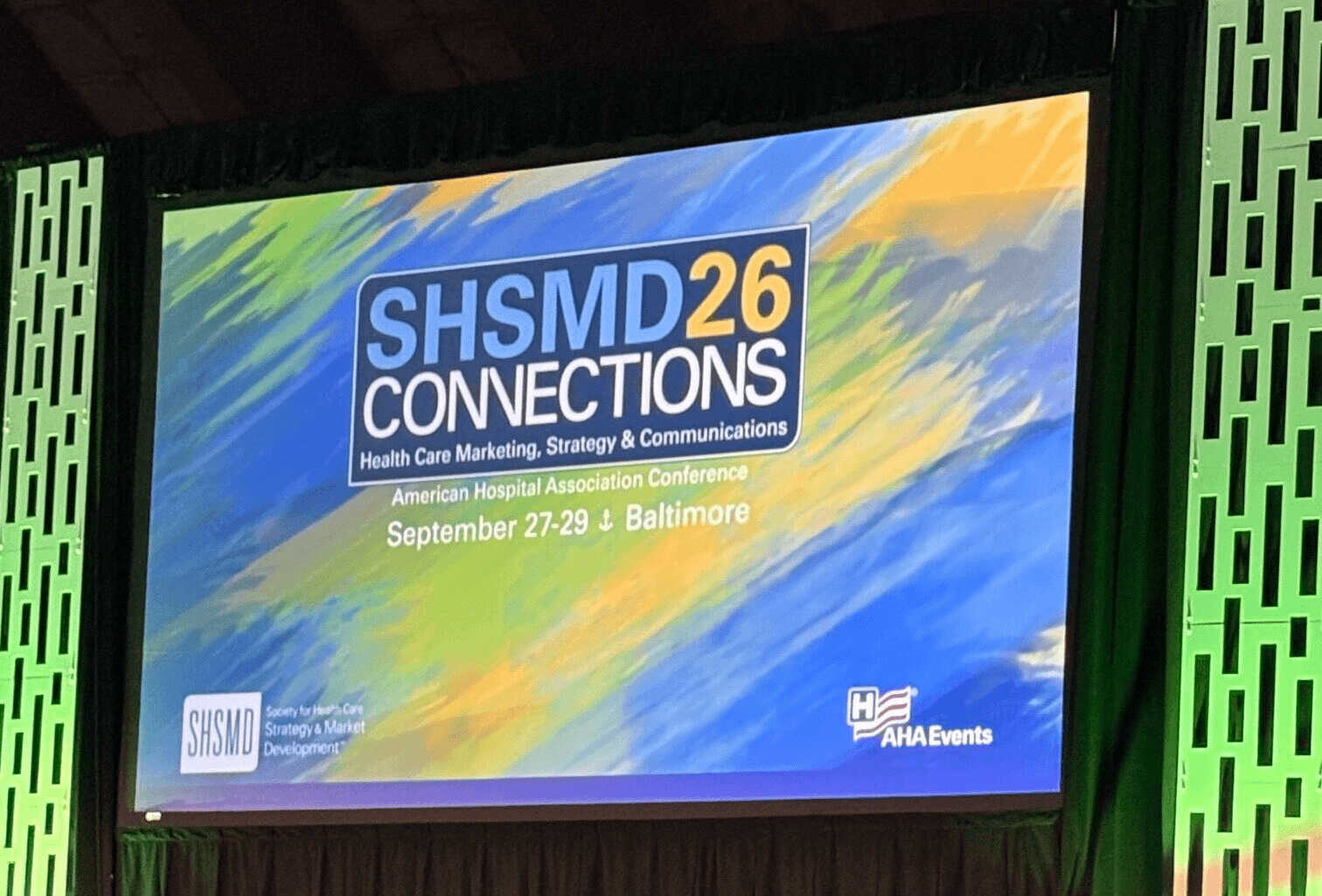
That’s why members of the BTA team attended the Society for Health Care Strategy & Market Development (SHSMD) Connections Conference in Baltimore, MD. We wanted to hear directly from healthcare leaders about the trends, challenges, and opportunities, and bring those insights back to our work.
But understanding what’s happening inside healthcare organizations is only part of the equation. We pair those insights with shifts in consumer behavior, technology, and the broader marketing landscape, along with what we are seeing in our own client work. Together, those perspectives help us develop strategies that address real needs and move the needle.
SHSMD did not disappoint. We came back with plenty of ideas and new perspectives. Across sessions and conversations, one theme kept surfacing: healthcare marketing is moving both earlier and closer to care. That’s right: marketing is starting earlier in the patient journey and extending further into the care experience.
Here are 6 takeaways that stood out and that will help shape how we approach healthcare marketing strategy moving forward.
1. Access is marketing.
Marketing can get patients in the door, but first, we need to know there’s an open door to send them through.
Marketing and operations need to be aligned on where capacity exists and where growth is needed before campaigns launch. Generating demand for a service without the capacity to accommodate more patients creates frustration, not growth.
Instead, marketing can help fill available capacity where an organization is prepared to grow. That makes marketing more than promotion. It makes it part of the organization’s growth strategy.
2. Marketing starts before a patient schedules an appointment.
The patient experience begins in the community through events, conversations, searches, social media, reviews, and AI, long before someone needs care.
Every interaction shapes how people see and trust a healthcare organization. Marketing isn’t just about getting patients in the door. It helps build the relationship that may eventually lead them there.
3. AI is increasingly a front door to healthcare.
Patients are researching symptoms, providers, and care options before ever interacting with a health system. More adults are regularly using AI for medical questions, and 1 in 5 Gen Z respondents use AI to research providers.
That means healthcare organizations need to think beyond traditional search. Clear, useful, and trustworthy content needs to be structured so both people and AI platforms can find, understand, and use it.
4. Human connection matters even more in the age of AI.
Healthcare is becoming more frictionless through self-scheduling, automated follow-ups, AI, and other digital tools. But as healthcare becomes more automated, it also risks becoming less personal.
Use technology to make healthcare easier. Use people to build trust. AI can improve the experience and remove friction, but it can’t replace the human connection at the heart of healthcare.
5. Healthcare is serving more generations, and they don’t all experience care the same way.
Healthcare organizations serve multiple generations at once, and patients don’t necessarily find information, access care, use technology, or communicate with providers in the same ways.
Research presented at SHSMD showed that younger patients can have more difficulty navigating healthcare and are more likely to use tools such as AI in their healthcare decisions.
The takeaway isn’t simply to market differently by age. It’s to understand the people you’re trying to reach, how they navigate healthcare, and what they need to confidently take the next step.
6. Digital experience is care experience.
For patients, searching for care, finding a provider, scheduling an appointment, and receiving follow-up aren’t separate from the healthcare experience. They’re part of it.
Relevant messaging, simple scheduling, and reassuring communication can help people feel understood and confident about taking the next step.
That’s another reason marketing and operations can’t operate in silos. The experience promised through marketing needs to carry through to the appointment and beyond. Every handoff should make it easier, not harder, for patients to get the care they need.
We’re looking forward to bringing these insights into our 2027 planning and putting them to work for our healthcare clients.

Sydney Webb, PhD
Syd believes that health information should be as approachable as it is accurate.
With a PhD in communication studies and a background rooted in health literacy, she blends evidence-based insight with creative strategy to help people better understand their care, coverage, and choices. Her work sits at the intersection of storytelling and public health—ensuring that every message has a purpose and every audience feels seen.